Thursday, 1 November 2012

Child Birth: IN TAMANG

Child Birth:

The purification and naming ceremony of the child is done in three days after the birth of the child. Due to the influence of the Hindu religion practised by the Brahmins this is sometimes done within seven to eleven days after the birth of the child. According to the traditional customs of the Tamangs the father of child performs such ceremony. This is now done by the Tamang Lama or even by the Brahmin priest. The Holy Scriptures used by the Lama for such ceremony is called "Choi". On the sixth day the mother and the child are kept in a clean room after cleaning their bodies with water.

Pasni/Feeding Ceremony:
The feeding ceremony which is called Pasni is done after five months for a daughter and six months for a son. The Tamangs have a peculiar custom of feeding the child with a beak of a Maina bird. There is a belief that in doing so the child would start speaking sooner. The relatives and other persons are served with food and drinks on this occasion. They in return also present money or other gifts to the child.

Chewar/Hair Cutting Ceremony:
Chewar or Hair Cutting Ceremony is performed within three or twelve years. There is a tradition of an uncle shaving the hair of the child. The daughters of the family and other relatives are supposed to give gifts to the child on such occasion. There is also a peculiar traditional custom among the Tamangs of performing a Pasni of old person when he attends the age of eighty four years.

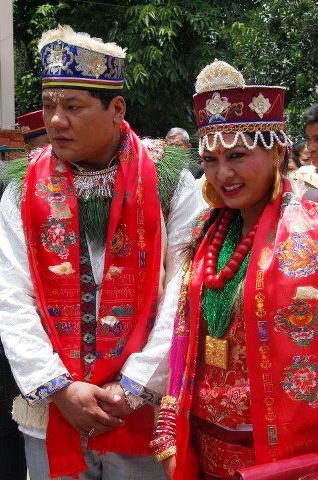
Marriages in Tamang

IMPORTANT for youngster of this generation.


Marriages in Tamang:

Inter marriage does not occur within the same subgroup (thahar as well as sahathar). Although inter marriage can occur between a boy, say belonging to the Thokar subgroup and a girl belonging to the Syangtan subgroup, if the mother of both the boy and girl belong to the same subgroup, however, marriage between them is not possible since they are socially recognized as the son and daughter of the same mother. There is the practice of marrying one's maternal uncle's and aunt's daughter.

Unlike in Hindu society, Tamang women do not adopt the last name of their husbands following marriage. Their thar or subgroup does not change; the woman remains in the same subgroup her entire life. When she dies, the body cannot be disposed without the presence and permission of her relatives. There is the traditional practice among Tamang daughters of undertaking small economic activities (Pewa) like keeping goats, chicken, etc. This enables the daughter to learn to stand on her feet and makes her self-reliant.
Marriages are of the three standard types: Arrangement Marriage, Capture Marriage and Mutual Agreement Marriage.

1. Arrangement Marriage:
Arrangements are made when they are only fourteen or fifteen years old. When the arrangements are agreed upon, the boy's father takes the boy and goes to the girl's parent's house accompanied by 40 or 50 people and brings the bride back to his own house, where the actual wedding ceremony takes place. The wedding consists of putting the tika (vermilion) mark on the forehead of both the boy and girl by all senior members of the family and relatives. The neighbours and relatives are fed boiled rice, mutton or buffalo meat and given much spirit to drink.

2. Capture Marriage: -
A capture marriage usually occurs when the boy selects a bride who may not consent easily or when he wants to avoid the long procedure and expenditure of an arranged marriage. It is done even in the case of preferred cross-cousin marriages to save trouble, time and expense. If the captured girl persistently refuses to get married for three days, she is allowed to return to her parents. If she agrees, a proper wedding ceremony is organized and friends and relatives, including the girl's parents are invited. A girl may be captured from a fair or a market. It her parents take the offence too seriously, they approach the boy's family making demands for compensation. Once they are pacified the rest of the procedure follows smoothly.

3. Mutual Agreement Marriage:
Most Tamang young people get married by mutual agreement. When a boy and girl are in love and decide to marry, the boy asks his parents to approach her parents for their consent. Once consent is given the wedding can be organized in the same way as in the case of the arranged marriage. If by any chance either the boy's or the girl's parents do not consent to the match the only choice for them is to elope and remain hidden until their parents either agree or totally ignore them.
If a man has only one daughter and no sons he can bring in a husband for his daughter to inherit and own property. The husband is not subsequently allowed to take another wife, but should he do so while he is enjoying the property of his first wife's father. It automatically goes back to his first wife. Should the wife leave the husband her father has brought in she is not entitled to her father's property; if she dies the husband can with her parents' permission marry another women.
Lamas(religious leader) usually marry the daughters of other Lamas and teach their sons to act as Lamas. "In this way" notes Furer-Haimendorf, "a class of lamas have grown up and though neither strictly endogamous nor formally privileged, this class now forms an upper stratum distinct from the ordinary cultivators. Lama however is a broad term. The priestly class among the sherpas and all the disciples and monks of any monastery are also popularly called "Lama". There is also a clan called lama among the sherpas. All non-Tamangs, when trying to be polite use the flattering term "Lama" for any Tamang individual.

Tamang Language

Tamang Language

Tamangs have their own dialect and script. Tamang dialect shares a lot with the Tibetan language. However, Tamang speak a slightly different language and the vocabulary differs in most of the cases and the language occupies fifth place among the languages of Tibeto-Burman family in Nepal. Tamangs have their own script called "Tamyik" which has beed recognised by the All India Tamang Buddhist Association, Darjeeling, Nepal Tamang Gedun, Katmandu and Sikkim Tamang Buddhist Association from June 1998. Some Tamang scholars like Amrit Yonjon and Pempa Tamang have been doing research on the Tamang language. Foreign scholar Grierson George Hodgson, B.H.H. Anna Meria, Bryan T. Doreen and others have made useful research on the language. Recognition of Tamang language as one of the official languages is a very bold step and this will ultimately strengthen the main Nepali language. Tamang language is the largest Tibeto-Burman language in Nepal.
1. Dialects: According to 1991 census the Tamang language has further been subdivided into the following dialects- Eastern Tamang: 759,257 in Nepal . Population total all countries: 773,257; Western Tamang: 322,593; Southwestern Tamang: 109,051; Northwestern Tamang: 55,000; Eastern Gorkha Tamang: 3,977 .
2. Grammer: Some grammatical features of Tamang languages are- postpositions; genitives after nouns; question word medial; ergative; Phonetically Tamang languages are tonal.
3. Writing system: Tamang languages use Tam-Yig which is similar to Tibetan scripts and Devangar. In many situations, however, Tamang is written in Devangar proper.

Tamang Societal Leaders

Societal Leaders


The Tamangs have a system of six types of societal leaders: Tamba, Ganba, Bonbo, Labonbo, Lama and Choho to keep the Tamang society continuously alive and dynamic. The six have their respective and important roles to play in the development of Tamang society. The Tamba looks after the cultural aspect and has a very important role to play in marriage ceremonies. The Lama carries out death rites (Ghewa) and undertakes activities related to the Buddhist religion. The Bonbo propitiates the local gods and goddesses and assists by providing treatment to the sick and needy in the village. The Labonbo (Laptaba) keeps alive the history of the clan and lineage through the worship of clan deities. As each thar or subgroup, has its own Pholan or clan deity, there are different Labonbos for each and every subgroup. The Choho looks into cases and dispenses justice and maintains peace, security and well being in society. The Ganba participates in all types of social, political and religious activities. He observes the various activities of society, including whether the Tamba, Bonbo, Lama, Labtaba, Choho, etc have fulfilled theirfunctions as prescribed by rituals and to the best of their ability or not, and evaluates the activities and gives his suggestions. Thus, the six societal leaders or actors continue to make the Tamang society aware of its duties and responsibilities. There are also in Tamang society traditional institutions like Nhangkhor active to undertake socio-cultural activities.

Tamang Selo (Nepali Tamang Dance)

Tamang Selo (Nepali Tamang Dance)

Tamangs are part of Nepali community, the ancient and inhabitants of the mountains and plains of the Himalayan regions of Nepal and India. "Tamang Selo" dance is performed to the rhythmic sound of the "Damphoo" musical instrument which the dancers carry in their hands. This dance is therefore also called the "Damphoo Dance". Tamang Selo is filled with fun and happiness; even the saddest person would smile once if he/she sees Tamangs dancing with Damphoos. May be that’s why Tamang Selo has become the most popular dance form in Nepali community.

The Music of the Tamangs

The Tamangs are a music loving tribe. Their most loving musical instrument is the Damphu (tambourine). It is a small roundest drum where one side of the circular wood is covered by the skin of a goat which is joined with thirty two small bamboo pencils like pieces. A legend has it that in the ancient time when the Tamangs moved from one place to the other in search of food and shelter they lived by eating wild fruits, edible yams or meat of the wild animals. It was a kind of community life where they shared food in their temporary shelter.
The Tamang songs are known as "Tamang Selo". There are light songs as well as songs with philosophical thoughts. Tamang light songs are called Fabar Wohoi. These songs express the day to day joys and sorrows of the life. The Songs containing philosophical thoughts are generally sung by the Tamba which is called Tambala Wohoi. There are also duet songs which are sung between two parities in the form of questions and answers, one party put some riddles which the other party has to reply in time.

The different kinds of Wohoi Songs are as follows: -

• Sangla Wohoi: - It is a kind of obeisance offered to Gods and Goddesses of different regions and directions.
•Sayr Geymla Wohoi: - It is sung while offering sacrifices to God.
• Moibala-Hai-Wohoii: - It is a kind of prayer asking for the blessing of the God and Goddesses asking blessing from them to enable to sing rightly.
• Damphu Sengba Wohoi: - It is the song on the creation of the musical instrument Damphu.
Tamang Selo has transcended the boundary of linguistic, cultural and social limits. All other Nepali Communities have adopted selo in their music and emotional expression.
• Sacjoua Nam Chiya Wohoi: - It is the song of the creation of the universe.
• Nela Wohoi: - It is a song of the various places.
• Guudni Chayala Wohoi: - It is the song on the origin of the sacred Ganges.
• Raoichen Chyopghy Wohoi: - It is the song on the different clans and sub-clans of the Tamangs. All the above type of songs contains deep philosophic and religious thoughts. There are songs of humour and wit, philosophical thoughts and of joys and sorrows of life as well. The natural surrounding around which they live have made them sentimental and emotional and such feeling have come out from their heart naturally.

Review


Review:-
The Tamangs (Devnagari: तामाङ; tāmāng) are the ancient and original inhabitants of the mountains and plains of the Himalayan regions of Nepal and India. Their ancient capital being Yambu - modern day Kathmandu. They have their own distinct culture, language and religion. Their ancestral domain (land) is popularly known as Tamsaling. Tamsaling extends from Buddigandaki in the West to Dudhk
oshi in the East and from the Himalayan range in the North to Chure or Siwalik hills in the South. ‘Tam’ refers to the language spoken by Tamang people, ‘sa’ refers to the land and ‘ling’ refers to the territory or fragment. So, ‘Tamsaling’ mean the land of Tamang tongue speaking people. Through the centuries, due to foreign invasions, they moved to other parts of South Asia. Today, they inhabit practically the entire mountainous regions of Nepal and also adjoining regions of India, Myanmar, Bhutan, and Tibet.

In Nepal, Tamangs are predominately found in the districts of Sindhupalchowk, Rasuwa, Kathmandu, Bhaktapur, Lalitpur, Dhading, Makwanpur, Nuwakot, Ramechhap, Dolakha, Chitwan and Kavreplanchowk. A small number of Tamang who migrated from Nepal can also be found in the hilly regions of India. Living mainly in the north and east of the country, they constitute 5.6% of Nepal's population, which places their population at 1,280,000, slightly higher than the Newars.

Tamang are rich in socio-cultural perspectives. They are the only indigenous nationalities who are least affected by the process of Nepalization. As a result of their success to maintain their distinct identity despite the state sponsored process of Nepalization they are highly marginalized and exploited by the state. Extensive poverty and illiteracy are found in large scale. They are very rich in their culture but their economic condition is worse. Even after the restoration of Democracy in 1990, their economic status has not been changed.

Many Tamang clans do not permit intermarriage with other ethnic groups, although some clans do permit intermarriages with the Gurung, Magar, Kiats, and Sherpas. Their descent is traced patrilineally.

तामाङका थरहरु

तामाङका थरहरु

तामाङका थरहरु हालसम्म १४८ वटा भेटिएका छन् ।

क्र.सं
१.बज्यु २.बल ३.बलदोङ ४.बामतेन ५.ब्लेन्देन ६.ब्लोन ७.बम्जन ८.ब्राङदोङ ९.ब्रासिङगर १०.चाकेन्गोचुमी ११.चेलेङगार्ते १२.छेकपाल १३.छ्योईमी १४.चिम्कन १५.छोदेन १६.च्यापाङखोर १७.दामराङ १८.दारताङ
१९.डिमदोङ २०.डन २१.दोङ २२.दोङपा २३.दोसिङ २४.डुम्जन २५.फिउवा २६.गाल्देन २७.गाङताङ २८.गेमसिङ
२९.ग्यावतेन ३०.घले ३१.घिसिङ ३२.घुन्सादे ३३.घुन्सादेन ३४.ग्लान ३५.गोले ३६.गोम्च्यो ३७.गोम्देन
३८.गोम्जा ३९.गोन्देन ४०.गोङ्वा ४१.गोङ्वो ४२.गोङ्सो ४३.गोथर ४४.ग्राङदान ४५.ग्राङदेन ४६.ग्रोम्बा
४७.ग्रोम ४८.ग्रोप्चन ४९.ग्याबा ५०.ग्याव्तेन ५१.ग्याम्दान ५२.ग्याम्देन ५३.ग्याङताङ ५४.ग्योमचो ५५.हेन ५६.हिम्टुङ ५७.होप्तेन ५८.जिम्बा ५९.जोग्ना ६०.जोन्गान ६१.जुमि ६२.कागते ६३.काल्देन ६४.कमैवा ६५.काम्देन ६६.खानीखोर ६७.ख्युल्पा ६८.ख्युङवा ६९.कोल्देन ७०.कोम्ग्दान ७१.लला ७२.लामागोन्जु ७३.लामाखोर ७४.लो
७५.लामिनखोर ७६.लोप्चन ७७.लुङवा ७८.लुङपा ७९.महेन्दोङ ८०.माम्वा ८१.मनाङथेन ८२.मान्देन ८३.मार्पा
८४.मेन्सिङ ८५.मिकचन ८६.मितक ८७.मोदेन ८८.मोक्चन ८९.मोक्तान ९०.मुलुङ ९१.म्याल्पा ९२.नाजुङ ९३.नेगी ९४.ङाके ९५.ङार्वा ९६.ङार्देन ९७.ङिल्पा ९८.ङोङचो ९९.ङयोजो १००.ङयाचेन १०१.न्यासुर १०२.न्यारवा
१०३.ङयोङदोङ १०४.पाल्देन १०५.पाजुतेन १०६.पाखरिन १०७.पाल्चोके १०८.पाङवोतेन १०९.पाङतेन ११०.फेवा
१११.प्रभुवा ११२.रम्पोद ११३.रिम्तेन ११४.रुम्बा ११५.साइ ११६.साम्देन ११७.साङग्री ११८.सर्वखोर ११९.सेङजेवा
१२०.सेनतेन १२१.स्वाङवो १२२.स्याङरी १२३.स्योरतेन १२४.सिङगन १२५.सिङगर १२६.सिङतान १२७.सुक्तान
१२८.सुम्बा १२९. स्याम्जन १३०. स्याङजुवा १३१.स्याङतान १३२.सयाङदन १३३.स्यानतेन १३४.स्योङतान
१३५. स्योरतेन १३६.थाङतेन १३७.थीङ १३८.थोकर १३९.तितुङ १४०.तोइवारा १४१.तोइसाङ १४२. तोङयार
१४३.तुन्बा १४४.तुपा १४५.वाईबा १४६.वालिम १४७.योर्सादेन १४८.योन्जन